UK household recycling habits
Starting with which items Brits are recycling the most, 92% said they recycle paper and card, followed by 91% of people recycling plastic. A further 85% of UK households also stated they recycle glass; however, this number drops down to 63% for metals such as tins.
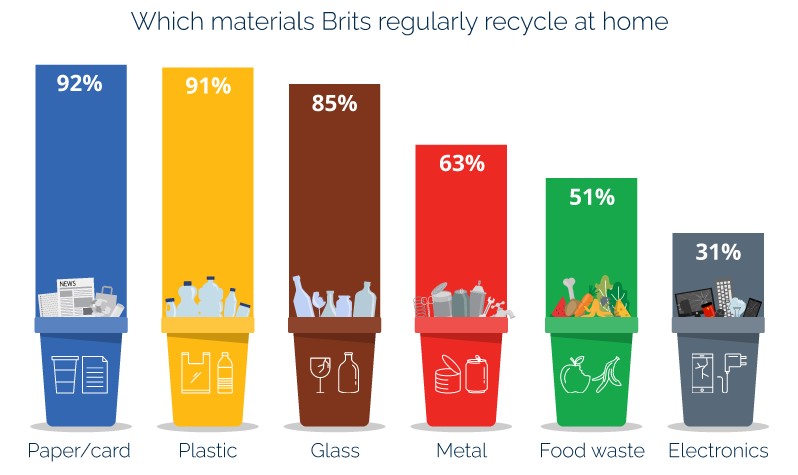
The data also revealed that over half (51%) of UK households are actively recycling their food waste at home, with a further third (31%) recycling their old electronics.
The study also found that only 13% were truly confident in their recycling abilities and knowledge. But which items are causing the most confusion?
Topping the list is plastics, with almost two-thirds (60%) unsure about which types of plastic can and cannot be recycled. This is followed by a third (31%) stating they struggle with electronic items, and a quarter (24%) with at-home metal recycling.
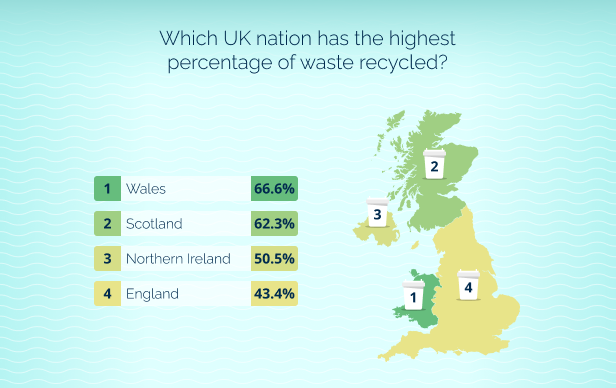
Which UK nation has the highest percentage of waste recycled?
By looking at recycling data taken from various governing bodies, we were able to determine which UK country has the highest percentage of waste recycled or reused.
The data revealed:
- Wales is the best at recycling, with an average total of 66.6% of waste actively being reused or recycled.
- Scotland follows in second place with an average recycling rate of 62.3%, with Northern Ireland following with an average rate of 50.5%.
- In last place is England, which recycles 43.4% of its total waste generated.
Regional Recycling Differences
It is worth noting that there is no one rule for recycling in the UK, as each local council has different guidance on what can and cannot be recycled in the home.
Because of these local differences, it is always worth checking your local area rules and regulations, as they can slightly differ.
.png?h=586&w=616&hash=D5B117FF8EB5AF430BF0CDA1C0270291)
One of the biggest differences between local councils in the UK is the colour of their bins. For instance, while blue bins are typically used for dry recycling across much of the UK, cities like Birmingham and Leeds opt for green-lidded bins instead.
Despite these regional variations, many residents feel confident in navigating their local bin systems. Topping the list are residents in the West Midlands and Wales, where 95% say they understand what each bin colour means.
Northern Ireland isn’t far behind, with 93% expressing confidence, followed by the South East at 92% and the East of England at 89%. Residents in the East Midlands and Scotland also show a strong understanding, with 86% saying they’re confident.
Further down the list, Yorkshire & the Humber reports 84% confidence, while 74% of those in the North West say the same. At the lower end, only 63% of people in the North East feel sure about their bin colour meanings.
As for London, nearly three-quarters of residents (73%) say they’re completely confident in using the correct bins.
As for which UK nations are the least confident in their local areas' recycling rules and accepted items, almost a third (30%) of those in England are not confident, followed by a quarter (25%) of those in Wales, 23% in Scotland, and 21% in Northern Ireland.
The data also found that one in 10 homeowners in England do not know their dedicated bin collection day, with this number almost doubling in Scotland to 19%.
The Most-Searched for Items
Looking at Google search data for different ‘can you recycle’ queries, we found the top 10 household items causing the most confusion.
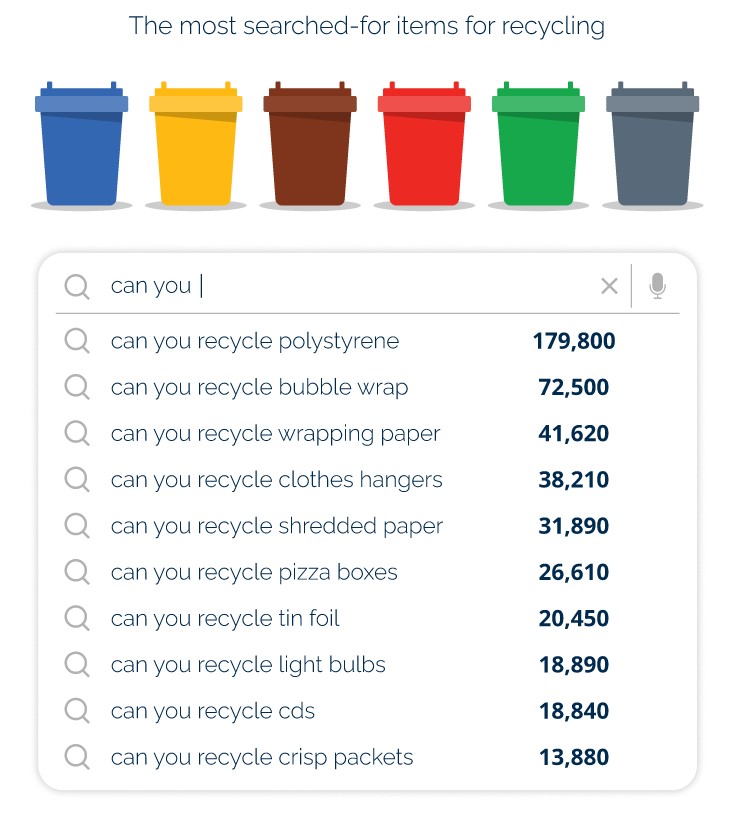
Topping the list is polystyrene, with a total of 179,000 searches. This is most commonly used for take-away food containers and to package white goods. This material cannot usually be recycled and should be placed in the waste bin.
Bubble wrap, another plastic, follows in second place with a total of 72,000 searches. Alongside plastic bags, it cannot be recycled at home but can be recycled at some out-of-home recycling points or in carrier bag collection points in supermarkets.
Wrapping paper rounds off the top three, with 41,000 searches. Only plain, paper wrapping paper can be recycled at home, in the cardboard collection bin. Any paper decorated with glitter or laminated with foil cannot be recycled and must be placed in the waste bin.
Other notable mentions from the selection include clothes hangers, crisp packets, and aerosol cans, which often cannot be recycled at home. In these instances, it’s worth checking your local recycling centres:
- Clothes hangers - usually cannot be recycled at home, but if they are broken, they can be taken to a local recycling centre for wood, metal, or plastic. Any non-broken hangers can be donated to some charity shops, which will use them again, or returned to some large retailers, who will recycle them.
- Crisp packets - are not widely recyclable in the home but can be recycled along with plastic bags and plastic wrapping at selected retailers and out-of-home recycling collections. Some local councils have started offering this service, but many still do not so it’s always recommended to check.
- Aerosols - can be recycled in the home and can be added to the metal waste (usually mixed in the plastic collection). However, it’s crucial to make sure the cans are completely empty before recycling to avoid the pressurised contents from exploding during the recycling process.
A third of Brits are guilty of ‘wishcycling’ at home
‘Wishcycling’ is the disposal of consumer waste in a recycling bin in the hopes of it being recycled, when it cannot or is unlikely to be recycled.
From the homeowner survey, we identified the top non-recyclable items Brits incorrectly thought could be recycled at home.
Topping the list are shopping receipts, with almost half (49%) believing they can be recycled at home. UK retailers hand out an estimated 11.2bn paper receipts every year, but not all of them can be recycled. The ones printed on shiny, thermal paper are not recyclable because they are coated with a substance called bisphenol A (BPA) or bisphenol S (BPS).
Drinking glasses followed next, with 39% thinking they can be recycled. Unlike regular glass bottles and jars, drinking glasses and glass cookware are non-recyclable. This is because they are heat-treated, so they do not melt at the same temperature as other glass items. Instead, you can recycle broken drinking glasses at your local recycling centre.
Kitchen roll rounds off the top three, with 38% believing it can easily be recycled. However, this is not the case because it is usually contaminated with food or grease, meaning it cannot be processed. It is also made with short fibres that cannot be further broken down. Instead, kitchen roll should be placed in the household waste bin, with the cardboard inner tube placed in the paper/card recycling.
Why is recycling contamination an issue?
Recycling contamination is caused by people putting the wrong things in their recycling bins, which either can’t be recycled at all or can reduce the quality of other recycling, making that unusable and unrecyclable.
If there is enough contaminated recycling in a collected batch, the entire truck load can be rejected and sent to a landfill site instead, even if a significant portion of the load is recyclable.
It is also a widespread issue, with the latest data from WRAP suggesting that over four-in-five (81%) of Brits dispose of something in their recycling that is not accepted in their local authority collection.
The three main ways to reduce recycling contamination
Gareth Rondel, Barratt’s head of sustainability delivery, has shared three core practices to help homeowners reduce their household recycling contamination:
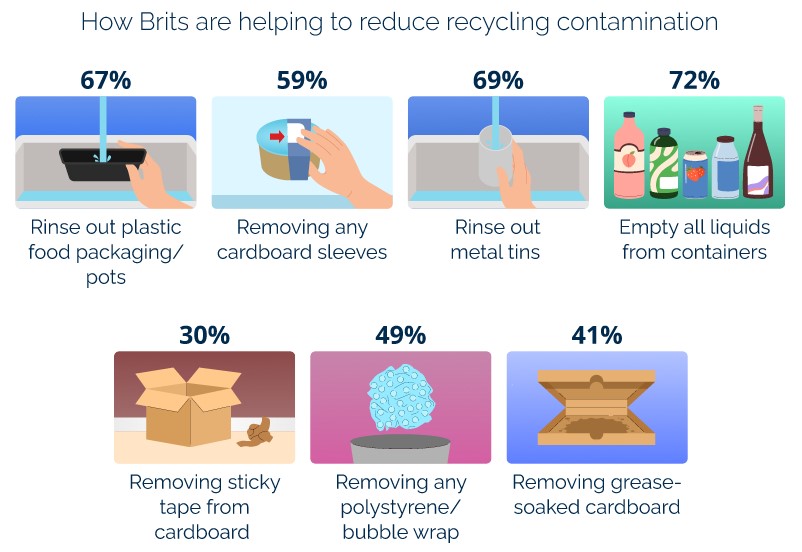
Sort – Waste in the home, in most cases, can be separated into three main categories: general waste, garden waste, and dry mixed recycling to avoid contamination.
In most cases, recycling can also be split, with plastic, tins, and glass being mixed in one collection and paper and cardboard in a separate collection.
Rinse – One of the most common types of contamination is items covered in food residue or containing leftover liquids. This can affect the quality of newly made materials, making them unusable.
This is why it is essential to rinse out any tin cans or plastic food packaging to remove any food residue.
Remove – This is a hybrid of sorting and cleaning, with a common example being cardboard with sticky tape attached - the sticky tape should be removed and placed in the household waste bin.
Many pieces of packaging are made up of cardboard and plastics, which need to be separated out to avoid cross-contamination.
The seven different types of plastic and their recyclability
When asked which items Brits find the most confusing to recycle, plastic topped the list, with almost two-thirds (60%) of homeowners unsure about a plastic item's recyclability.
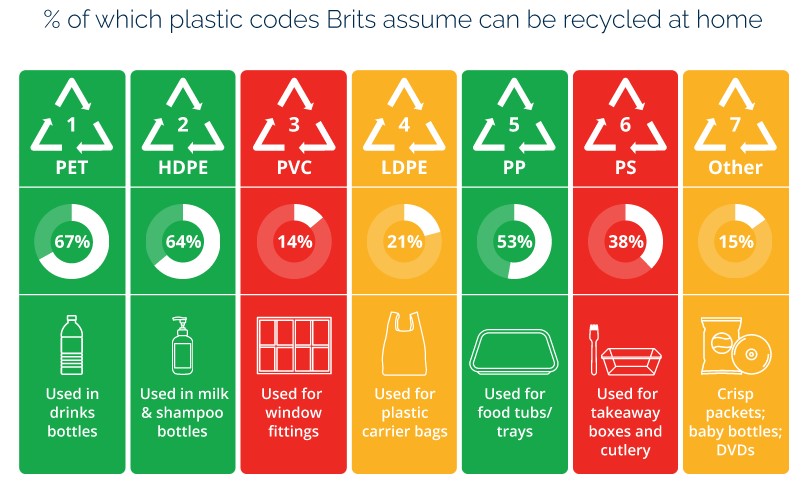
Looking closer at the seven different types of plastics, we uncovered a knowledge gap between what people believe can and cannot be recycled in the home.
1. PET (Polyethylene Terephthalate)
This is a common plastic found in most drink and condiment bottles, food containers, and even clothing. It can easily be recycled in the home waste collection.
2. HDPE (High Density Polyethylene)
This is typically found in most plastic packaging alongside milk bottles, shampoo bottles, and butter/yoghurt tubs. Again, this can easily be recycled in the home.
3. PVC (Polyvinyl Chloride)
This is a tough plastic commonly used to make window fittings, drainpipes, and even playground equipment. It cannot be recycled at all in the home and should be taken to a local recycling centre.
4. LDPE (Low Density Polyethylene)
This is a highly flexible plastic that is commonly used for packaging such as bread bags and frozen food bags. Most councils don’t collect this plastic for recycling at home, but it can be recycled at supermarket plastic bag recycling points.
5. PP (Polypropylene)
This plastic has a high melting point, which is why it is widely used for containers with hot liquids such as food tubs and trays. It can be placed in the home recycling collection, provided it is clean.
6. PS (Polystyrene)
This is known for its foam-like appearance and is used for take-away containers, disposable plates & cups, as well as in white goods packaging. It cannot be recycled at all and should be placed in the rubbish bin.
7. Other
This final type covers a variety of plastic types that don’t fit into the main six categories. These items can range from DVDs to sunglasses and baby bottles. These items usually cannot be recycled at home and should be donated or binned.
Two-thirds of Brits are guilty of bad bin etiquette
Not only is recycling contamination bad for the environment, but it can also lead to household fines of up to £400 from local councils for repeat offenders.
The Government website states that local councils have the authority to issue fixed penalties if homeowners do not follow the waste collection rules, leading to one of the following:
- Causes or is likely to cause a nuisance
- Has a negative effect or is likely to have a detrimental effect on local amenities
Other penalties of up to £100 come from not putting a bin out for collection at the correct time, as it can obstruct the street and possibly attract unwanted pests.
Although the specific guidelines can vary slightly from council to council, generally they state that household waste bins should be placed in position on the street between 7 pm the night before collection and 7 am the morning of the collection.
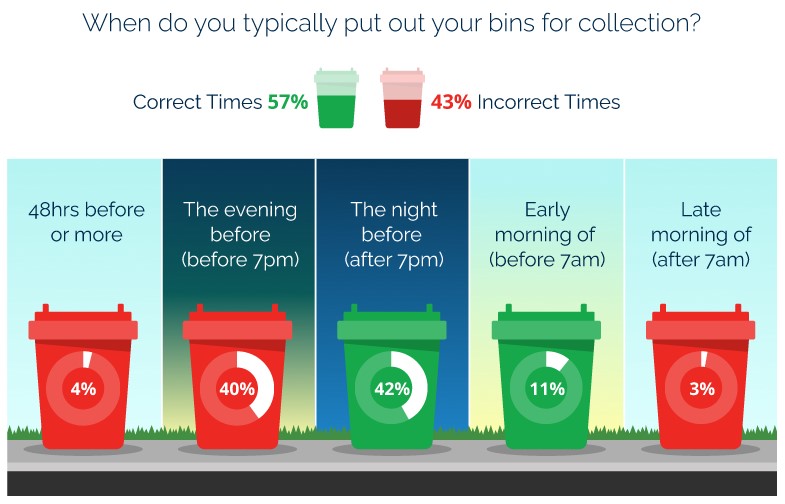
Despite this, almost half (47%) of homeowners are putting out their bins outside of this time frame, with 40% placing them out in the early evening before the 7 pm guideline.
Almost one-in-five (19%) are also guilty of leaving their bin out for several days after the collection, which can result in a fine between £80 and £100.
Other bad bin etiquettes the nation is guilty of include a third (31%) overfilling the bin so that the lid won’t close, which can result in a £60 fine.
A further 14% also put their rubbish into their neighbour's bins, a habit which could be classified as fly-tipping and lead to a large fine of up to £600.
Every David Wilson home is designed to give you more open space, more natural light, and an
energy-efficient home environment for you and your family.
As one of the leading new home builders in the UK, we have a wide variety of
new build homes across the country, as well as numerous
schemes and offers to help with your home purchase.
Methodology:
David Wilson Homes surveyed 2,000 UK homeowners on their knowledge, attitudes, and habits towards recycling in the home. UK-wide Google Search data was also gathered from the previous five years to assess the most searched-for items.
Government data was also gathered from the Local authority collected waste management report 2023/2024, updated in March 2025. Data was also collected from various government websites including DEFRA, SEPA, Stats Wales, and DAERA NI.
Desk research was also carried out using the local councils and government websites to establish possible fines. The number of UK households was taken from the latest ONS report.
*Recyclable items may vary by region/local authority, and the items have been kept as general as possible, but we cannot account for all local differences.