
Relocating is exciting, but it can also be complicated. Between packing when moving home, paperwork and completion dates, costs can quietly accumulate beyond what many homeowners budget for initially.
To understand the cost of moving in 2026, we sourced data from TaskRabbit to compare van removal services (sometimes referred to as a ‘man with a van’) across major UK cities with the cost of full removal services.
We analysed UK Reddit moving forums and surveyed 1,000 UK homeowners to uncover the most common financial pain points and the costs that are most often overlooked when moving. We also examined 12 months of Google search data to reveal the most and least popular times of year to move.
Steve Mariner, Sales and Marketing Director at David Wilson Homes, and Paula Higgins, CEO of the HomeOwners Alliance, share advice on how households can minimise financial and personal stress when moving homes.
When are Brits moving? The most and least popular times of year
Analysis of Google search data over the past 12 months reveals when UK homeowners are planning their moves and which times of year are most and least popular.

The most popular time to move: Summer (June–September)
The search data reveals that summer is the peak season for moving-related topics. Summer searches around finding removal services when moving home, including terms related to local movers and removal companies, reached their highest with a combined total of 300,000+. July was the most popular month, reaching 98,700 searches for moving-related queries.
The least popular time to move: Winter (December–February)
Winter, and February specifically, is the quietest period across all moving-related search topics, with Google searches reaching their lowest at 49,680.
How much does it cost to move home in the UK?
When budgeting for moving homes, removal costs can be hard to predict, with prices varying depending on factors such as access, labour, and extras like packing.
For most households, a typical 2–3 bedroom full removal can cost between £800 and £1,250, rising further if services such as packing or storage are added, according to Compare My Move.
While full removal companies are often the go-to for larger moves, many households, particularly those in 1–2 bedroom properties or moving locally, may use van removal services as a more flexible, cost-conscious alternative. Unlike full-service removals, which offer an end-to-end, hands-off experience and typically charge a fixed total, van removal services are usually priced hourly and better suited to smaller moves.
However, it is worth noting that hourly costs could exceed full-service removals if multiple trips are required, extra help is needed for loading, or the move runs over schedule.
Steve Mariner, Sales and Marketing Director at David Wilson Homes, said: “While it can be tempting to opt for the most cost-effective moving option, sometimes it could be worth investing a little more for a full service. For larger homes or long-distance moves, a full-service removal company can offer peace of mind, professional handling of your belongings, and a smoother overall experience, which can be well worth the extra cost.
“Everyone’s move is different. What works for one person may not suit another, so it's worth taking the time to weigh up your options based on your own circumstances, budget, and what will make moving day feel that little bit less daunting.”
We looked at data from service platform TaskRabbit to identify the average hourly rate for van removal services across major cities over the past year.
Annette Claisse Picardo, GM Europe at TaskRabbit said: “While moving services are in demand year-round, TaskRabbit sees a significant surge every spring and summer, reinforcing how much people rely on flexible support during the peak relocation season. Planning ahead and budgeting for practical assistance can make the move smoother and less stressful.”
Average van removal costs in England
Van removal services in England were sourced from TaskRabbit, based on hourly rates.
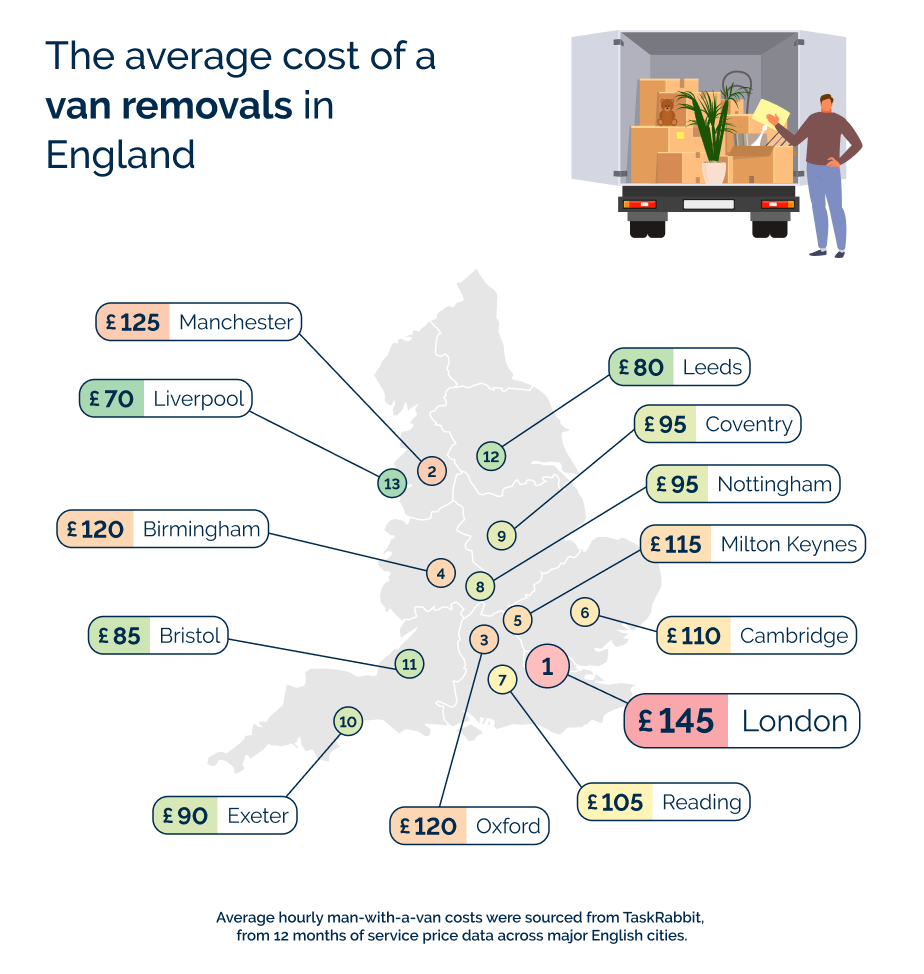
Based on a four-hour move, homeowners in Liverpool, the most affordable city, could pay as little as £280, which is up to 78% less than the upper estimate of a full removal service. In London, the most expensive city to move, a four-hour move at £145 per hour could come in at £580, still potentially saving movers up to 54% compared to a full removal quote. Manchester follows at £125 per hour.
With van removal services in Liverpool starting at just £280 for a four-hour move and new home developments in Liverpool continuing to grow, those relocating locally within these cities may find van removal services a particularly cost-effective option.
Average van removal costs in Scotland
We estimated the figures below using real hourly van removal rates from TaskRabbit in England, adjusted for Scotland using Numbeo cost-of-living data (full methodology below).
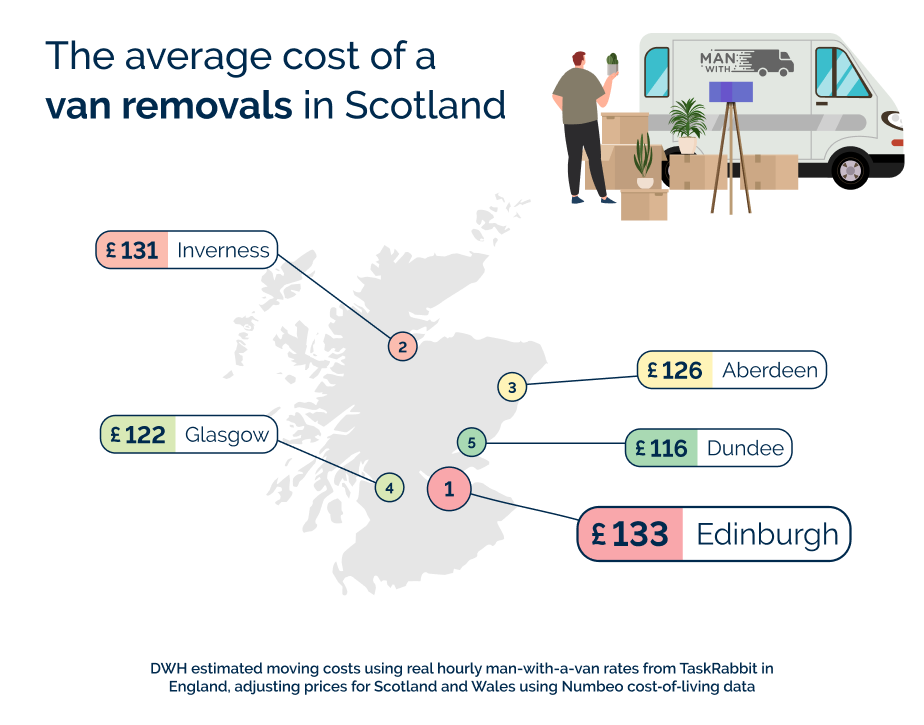
Edinburgh is the most expensive Scottish city for van removal services at £133, while Dundee is the most affordable at £116.
For a typical four-hour move, this would total around £532 in Edinburgh and £464 in Dundee. Compared to the lower-end average full-service removal cost of £800, this means a van-based move is around 33% cheaper in Edinburgh and 42% cheaper in Dundee.
Average van removal cost in Wales
We applied the same methodology for Wales, using TaskRabbit's England rates adjusted against Numbeo cost-of-living data.
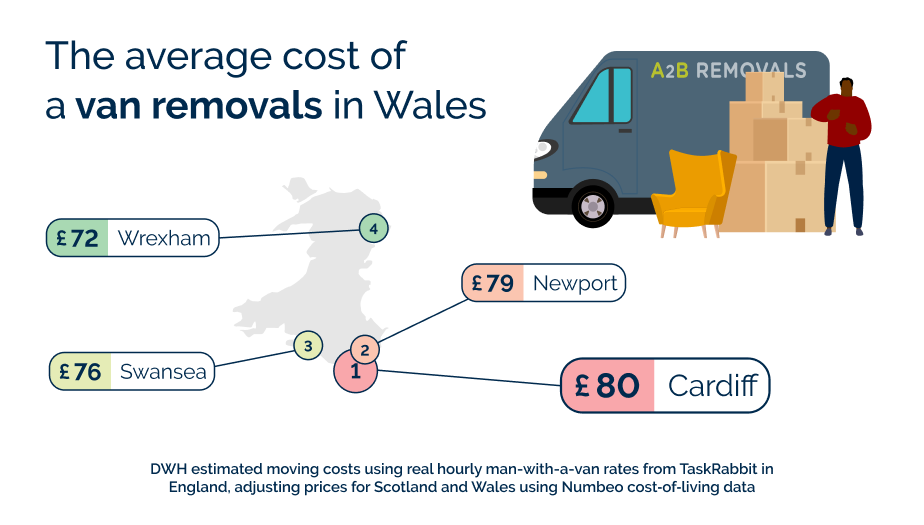
Cardiff is the most expensive Welsh city at £80, while Wrexham is the most affordable at £72.
For a four-hour move, costs reach around £320 in Cardiff and £288 in Wrexham. This makes van-based services around 60% cheaper than the £800 baseline in Cardiff and 64% cheaper in Wrexham. Overall, removal costs across Wales remain notably lower than those in major English and Scottish cities.
The top issues around the cost of moving homes, according to Reddit
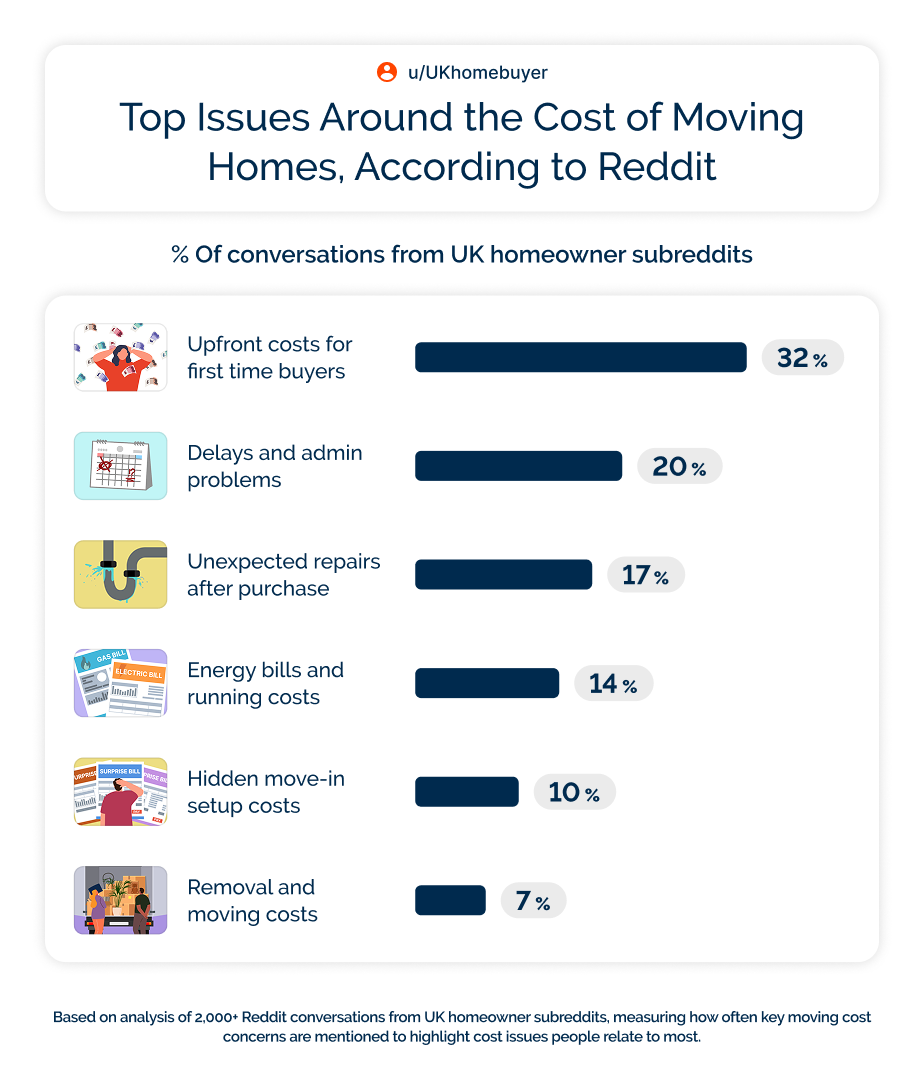
To understand the common concerns around moving homes, we reviewed 2,000+ Reddit comments from UK homeowner forums, looking at what people talk about most and what resonates most with others.
The four biggest moving cost concerns and what to do about them
Upfront costs for first time buyers (32% of mentions)
Nearly a third of all discussions around moving costs included the expenses that catch first time buyers off guard on moving day. Costs such as last-minute van hire, overnight storage, temporary accommodation and transport for are often overlooked ahead of moving day.
Reddit commenters said, “Completion was delayed by two days so I had to pay for a hotel and storage for my things” and “My transport fell through and I ended up spending £150 on taxis to get my things to the new place”.
Bigger costs that come with buying a home like stamp duty and solicitor fees could add more costs on top of what many first time buyers have saved.
New build homes can offer accessible routes onto the ladder, with government-backed schemes, lower deposit requirements, and part exchange home options often unavailable on older properties. This can ease the upfront burden when you're also facing other legal costs.
Steve Mariner suggests, “First time buyers should consider the full cost of purchasing a property, as expenses often go beyond the deposit to include surveys, legal fees, removal costs, and initial setup outlays. It’s also worth exploring all available first time buyer schemes, particularly those linked to new build developments that may offer options like a deposit boost up to as high as 5%.”
Delays and admin problems (20% of mentions)
Timing failures were also a significant talking point among home movers on Reddit, with many sharing how deeply the experience had affected them both emotionally and financially.
A Reddit commenter said, “I moved recently and the stress of buying and selling a house was personally much worse than having a mortgage has ever been we’ve had to deal with chains collapsing and bad solicitors and fussy buyers and all sorts of problems”.
When a chain collapses or a completion is delayed, the financial impact could be significant. Beyond the emotional toll, buyers can find themselves out of pocket in ways they hadn't anticipated and often at very short notice.
Chain-free properties, using a first home scheme, are reassuring in this sense. With no onward chain to collapse and build completion schedules set in advance, the biggest sources of timing failure are removed. Buyers know their moving date well ahead, making logistics planning far more reliable.
Steve Mariner says, “Book removal companies that offer flexible rescheduling policies, maintain a financial buffer to protect against timing failures, and consider chain‑free properties to eliminate one of the biggest issues of process risk.”
Unexpected repairs after purchase (17% of mentions)
Discovering building problems after homeowners have already moved in and the costs that follow were also widely discussed.
In older homes, some people may find issues hidden behind walls, beneath floors, or within ageing systems that can go undetected until they become expensive problems.
Within Reddit communities, homeowners report damp treatments, boiler replacements, electrical work, and structural repairs arriving unexpectedly in the months after moving in.
A Reddit commenter said, “We bought a house this spring and we were initially looking at something around 170k. Yet my partner insisted on a better area for safety and schools, so we ended up spending 270k overpaying by about 25k because we were so inexperienced we also later found out it needed a full rewire and other major repairs, adding to the costs”.
While many homeowners face this in older homes, buying a new build home comes with 10-year NHBC warranties, meaning that defects are covered rather than absorbed by the buyer. Therefore, surprise repair costs that trouble 17% of movers could be avoided.
Steve Mariner says, “Buying an older property could come with hidden surprises, so it's always worth getting a Level 2 or Level 3 survey before you commit. Setting aside a small emergency fund for repairs can also give you peace of mind once you've moved in. With a new build, there's a little more certainty. Structural warranties won’t cover every repair cost, but protection for fixtures and fittings alongside a structural warranty can provide added reassurance and help you feel more settled in your new home.”
Energy bills and running costs (14% of mentions)
The final most discussed issue is unexpected costs of running and maintaining a home.
Many buyers may underestimate the price of essential upgrades or emergency fixes when moving home. Home running upgrades could include plumbing, boilers, heating systems, electrical repairs, and general energy efficiency improvements. Setting aside some allowance set aside may make encountering necessary upgrades less pressurising on budgets.
A Reddit user said, “Older homes can be expensive to run (we were paying around £200/month in winter), so we ended up downsizing to something more efficient rather than spending tens of thousands on upgrades, things like batteries and heat pumps can help, but the upfront costs are still pretty steep.”
Steve Mariner says, “When budgeting for a move, don’t just account for mortgage payments and furniture; it’s worth building a dedicated ‘systems and maintenance’ fund. Set aside at around 5-10% of your property’s value over the first five years for essential upgrades like boiler replacement and energy‑efficiency improvements to help keep the upkeep of your home more manageable. New build homes are built to the latest energy efficiency standards which means buyers could benefit from significantly lower energy bills compared to older properties.”
The top moving costs UK homeowners worry about
We conducted a survey to delve into the costs UK homeowners worried about when moving, the ones they had not planned for, and the ones they simply forgot.
Legal fees are the biggest concern when it comes to extra moving costs
Almost two thirds of homeowners (64%) said solicitor and conveyancing fees were their biggest concern, with stamp duty close behind at 51%. These tend to be the hardest costs to pin down during the process, which is likely why they cause so much anxiety.
Survey costs worried the majority (32%) of respondents as well as removal company fees at 30%. Followed by, estate agent fees (27%), mortgage arrangement fees (18%), storage costs (18%) and packing materials at 11%. Cleaning costs were barely a concern at just 3%.
Last-minute repairs and storage are where surprise costs hit hardest
Just under half of respondents (46%) said they had no surprise costs at all. But for others, the unexpected expenses varied. Last-minute repairs were the most common, catching out 23% of homeowners, followed by storage between properties at 22%. One in seven people (15%) ended up paying for extra removal hours, while 8% needed a bridging loan to cover the gap between buying and selling.
Council tax overlap is the cost people forget most often
A quarter of respondents (25%) forgot to budget for council tax overlap, which can result in paying tax on two properties at the same time. Broadband installation or early exit fees were overlooked by 19%, new furniture by 16%, and utility connection or exit fees by 15%. Changing the locks and updating a TV licence address were each forgotten by 14% of people, while deep cleaning slipped the minds of 13%.
Moving house checklist: The costs to budget for
Paula Higgins, CEO of the HomeOwners Alliance, shares her top tips for moving house in a handy checklist of things to consider:
Before exchange: “Secure your mortgage arrangement fee and valuation early, as these are non-negotiable before any offer is accepted. From there, budget for a homebuyer survey, solicitor fees, property searches, and stamp duty land tax - all of which should be confirmed in writing before you proceed.”
Before moving day: “Book your removal company as early as possible; availability tightens quickly, particularly around weekends and end-of-month dates. Alongside this, account for packing materials, storage if needed, utility notifications, and mail redirection - the latter is easy to forget but important to set up before you leave.”
On moving day: “Take meter readings at both properties with photos and timestamps the moment you arrive and leave. Keep a small fund aside for transport and any emergency costs and confirm key and access arrangements with all parties in advance.”
After moving in: “Factor in a deep clean or professional cleaning service, any immediate repairs or replacements, and window treatments such as curtains or blinds, which are often not included in a sale. If white goods (kitchens and dishwashers) are not part of the deal, budget for those separately alongside broadband setups, parking permits if required, council tax registration, and a full address update across all accounts.”
Contingency budget: “Set aside 10 -15% of your estimated moving costs as a buffer. Timing failures, unexpected repairs, and setup costs are the three areas where actual spend most commonly exceeds the plan.”
Moving home in 2026 doesn't have to be a financial shock. Budget for what you know and take the time to explore all your home options.
Methodology
We analysed 2,000+ Reddit comments from UK-focused subreddits relating to moving home. Posts were identified using keyword searches linked to buying, moving and unexpected housing costs, and unrelated rental or landlord content was removed.
Comments were grouped into recurring issue categories, with mentions and upvotes used to indicate how common and widely felt each challenge was. The aggregated results were then used to identify the most prominent financial pressures and process-related issues associated with moving home.
We also analysed monthly Google search demand data over the past 12 months, from Google Keyword Planner to measure interest in moving and home ownership costs.
We surveyed 1,000 UK homeowners to gain insight into the costs they overlooked when moving.
Van removal pricing (sometimes referred to as man with a van) is based on TaskRabbit hourly rates across major English cities. DWH then compared these rates to estimate Scottish and Welsh rates using Numbeo cost-of-living data.
We used data from https://www.comparemymove.com/guides/removals/removal-company-cost for the average full removal costs in the UK.
Related Articles
-

Moving Home Checklist
Aug 14, 2025 -

Moving Day Top Tips and Advice
Oct 12, 2023


