
Buying your second home can be an exciting step, but it also introduces new steps that many buyers may not have encountered the first time around. Whether you are upsizing, relocating, or moving to a new area, second‑time buying can involve more complex legal checks, more financial decisions, and the added pressure of coordinating both a sale and a purchase.
To gain insight into UK homeowners' concerns around second-time buying, we analysed UK Reddit home forums to understand the key challenges of buyers going through the process. Steve Mariner, Sales and Marketing Director at David Wilson Homes, shares tips on how to make second-time buying less stressful.
We also conducted a survey of 1,000 UK homeowners. The findings revealed that almost two-fifths (35%) of second-time buyers found their second purchase more stressful than their first, and 46% said it felt about the same level of difficulty. Whilst only 19% found it easier.
The buying process is one many people assume becomes simpler with experience but our research highlights that moving again can be just as hard the second time.
The most underestimated second-time buyer costs
Many second-time buyers may assume because they’ve bought before, they know the financial realities of moving again. But selling a property while buying another can significantly increase overall costs.
Our survey of 1,000 UK homeowners shows the costs most underestimated by second-time buyers.
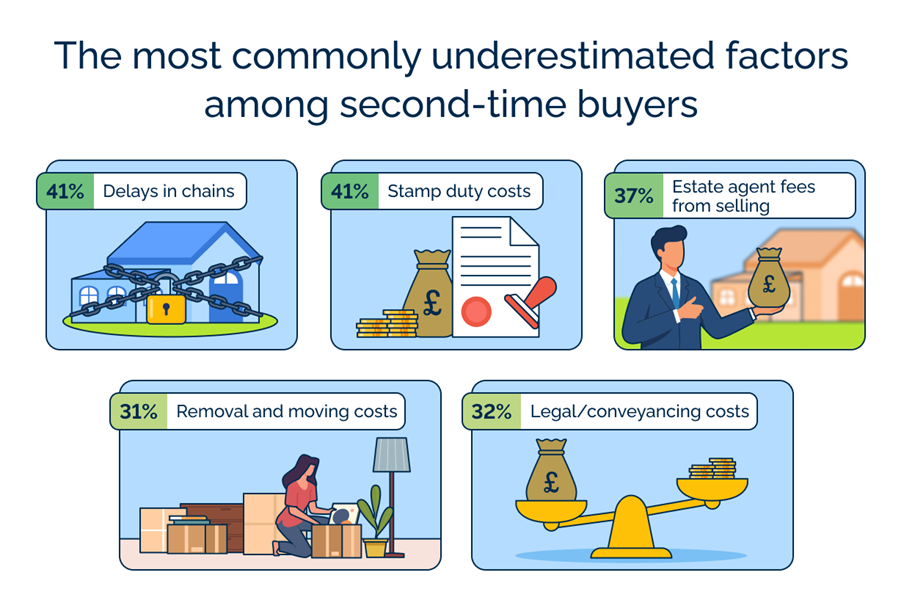
Costs incurred from chain delays (41%)
Second-time buyers are more likely to be part of a lengthier property chain than first-time buyers, as they also have to sell their current home and delays can quickly become costly. A chain that falls through could mean wasted survey fees, while postponed moving dates may lead to storage costs for belongings, and removal companies can charge waiting time fees.
Stamp duty costs (41%)
Unlike many first-time buyers, second-time homeowners rarely benefit from stamp duty relief. Calculating the exact liability before making an offer and factoring it into an affordability assessment from the outset can help avoid any unexpected costs close to completion.
Estate agent fees from selling (37%)
Agent fees can take a significant pool of money out of your equity. Clarifying what’s included in the service, such as photography and premium listings, can help ensure an accurate comparison between agents.
Legal and conveyancing costs (32%)
Coordinating a purchase and a sale means you will be liable for legal fees on both sides, so having your solicitor outline all expected costs upfront is sensible. Some may offer ‘no move, no fee’ guarantees to protect you if the chain collapses.
Removal and moving costs (31%)
Second-time buyers typically move with more possessions than first-time buyers, which can push removal costs higher than anticipated. The day and time of a move, as well as any additional services such as packing or short-term storage, may affect the final costs.
The most common challenges for second-time buyers
To gain insight into the most common challenges for second-time buyers, we analysed 4,000+ Reddit comments from UK home forums to reveal the common issues second‑time buyers face the most.
On Reddit, users can “upvote” posts they find helpful or relatable. High upvote numbers don’t represent official statistics, but they do show which issues resonate the most with buyers.
The top five challenges discussed on Reddit

1. Legal & Conveyancing Failures (36,140 upvotes)
While legal and conveyancing complications can affect any buyer, second-time buyers may be more likely to encounter them, particularly when upsizing to a larger or older property. If you're selling a home you've owned for many years, your solicitor may also need to track down documents relating to your current property, including proof and source of funds, leasehold terms and charges, and title deeds and planning permissions.
Older homes such as Victorian properties may not have complete planning records for loft conversions, extensions or past renovations. This can force solicitors to pause the process while they arrange an indemnity policy, a type of insurance that covers missing paperwork or legal uncertainties.
A Reddit commenter said, “The conveyancing process was fairly arduous, and I had to stay on top of it at every stage. We completed just under four months later, but there were a few tricky moments along the way, including coordinating the repayment date for a Help to Buy equity loan. The seller, who was being repossessed, was also unresponsive at a crucial point, which delayed the exchange close to the completion date.”
2. Planning, Privacy & Neighbour Disputes (32,159 upvotes)
Issues like unapproved extensions or neighbour disputes are not often obvious at the viewing stage, but can surface during searches and surveys and cause significant delays. For second-time buyers seeking more space or privacy, uncovering these issues during the transaction may add unexpected delays to their move.
3. Property Chain Collapse (22,046 upvotes)
As second-time buyers also need to sell their current home, they can run into more problems with the property chain. For example, a mortgage offer may be delayed from their buyer or someone may withdraw further up the chain, which can impact months of preparation, sometimes without much notice or a straightforward legal solution.
One Reddit user said, “We were told the property had no onward chain, only to discover we’d been pulled into one. Now we’re stuck with no clear completion date, and no one can give us answers; meanwhile, we’re carrying all the financial and emotional strain of the delay.”
4. Boundary & Title Disputes (15,410 upvotes)
A boundary dispute is when there is uncertainty about where the legal edges of a property begin and end. This can include questions about who owns a shared fence or wall, whether a driveway is solely or jointly owned, or whether a strip of land next to the property is formally registered.
These issues may be more common in older properties, where the legal plans may not match what is physically on the ground. They can take time to clarify and are a frequent source of delay and discussion among second-time buyers.
A Reddit user said, “I received a letter from a utilities management company stating that they manage the land on behalf of the water company and that I would need to remove my raised beds and gate. The letter said that if this wasn’t done by a specified date, they could arrange for a contractor to remove them and seek to recover the costs from me.”
While boundary disputes can affect any buyer, they may be more likely to arise for second-time buyers, particularly those upsizing from a flat where boundary disputes are far less common.
5. Gazundering & Last-Minute Price Drops (14,528 upvotes)
Once a property has been taken off the market and the seller is in a chain themselves, buyers may recognise this as a position of weakness and lower their offer just before contracts are exchanged. Turning down that reduced offer risks the entire chain collapsing, which most second-time buyers can't afford. If a buyer has had the offer on their own property reduced, they may also have little choice but to pass that reduction up the chain, leaving the second-time buyer out of pocket.
A Reddit user said, “As the title says, we were due to exchange contracts tomorrow in our chain, but this afternoon our buyer emailed asking to knock £20k off the price after their survey report came back with a list of repairs.”
The top asked Reddit questions around second time buying in the UK
As well as analysing the top challenges second-time buyers face on Reddit, we also examined the most asked questions around buying a second home.
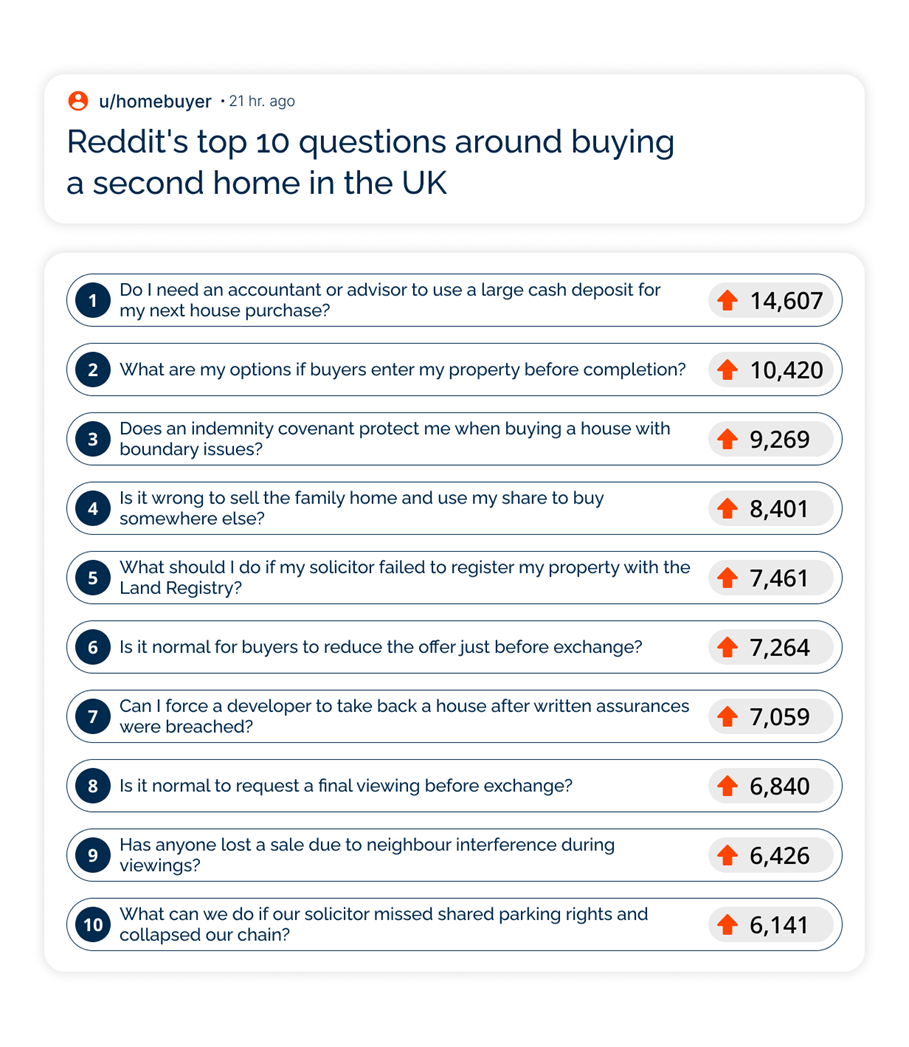
1. Do I need an accountant or advisor to use a large cash deposit for my next house purchase?
(14,607 upvotes)
Just like your first property, it’s sometimes required for movers wanting to upsize to save money to put down an additional deposit. It’s not a legal requirement, but having professional support can make the process a lot smoother. Solicitors and lenders will need to verify where the money came from, as this is standard practice under anti‑money laundering rules, so providing clear documentation upfront usually prevents delays during conveyancing. A financial adviser may also be helpful if the source of the funds has potential tax implications.
2. What are my options if buyers enter my property before completion?
(10,420 upvotes)
Until the keys are handed over at completion, the property is still legally yours. If a buyer enters without permission, even for something minor like measuring up, it's worth flagging to your solicitor. In most cases, a letter between solicitors is enough to resolve it.
If any damage has been caused, there may be options to seek compensation, though in practice, most situations like this are resolved without it escalating further.
3. Does an indemnity covenant protect me when buying a house with boundary issues?
(9,269 upvotes)
Indemnity covenant is a legal promise, where a property buyer promises to take on responsibility for any existing obligations or restrictions attached to that property and to cover any costs if those obligations are ever breached.
Each time the property changes owner, the new buyer makes the same promise, creating a chain of indemnity covenants that ensures responsibility follows the current owner rather than leaving previous owners exposed. In this way, the covenant is designed to protect the seller rather than the buyer, meaning the buyer is the one taking on the obligation.
Where boundary issues are involved, this means a buyer may be taking on liability for an unresolved historic dispute rather than being protected from one.
4. Is it wrong to sell the family home and use my share to buy somewhere else?
(8,401 upvotes)
Selling a family home that holds a lot of memories can be an emotional process, but it’s important to consider finances and legality, too. If money is legally entitled to you, then there may be more leeway to use that to buy another property.
Things can get more complicated in cases involving divorce or inherited property, where how the money is divided may not yet be legally agreed. In those situations, each person's entitlement may need to be confirmed before any funds are used.
5. What should I do if my solicitor failed to register my property with the Land Registry?
(7,461 upvotes)
Delays at the Land Registry are not uncommon, and in some cases, an application may have been submitted but not yet processed. Where no application appears to have been made, this is considered a more serious matter.
Formal complaints can be raised with the solicitor directly, and if the response is unsatisfactory, both the Solicitors Regulation Authority and the Legal Ombudsman are available routes for escalation.
The most searched for topics around second-time buying
We examined historical Google search data over the past few years to find the most searched-for second-home buying topics.
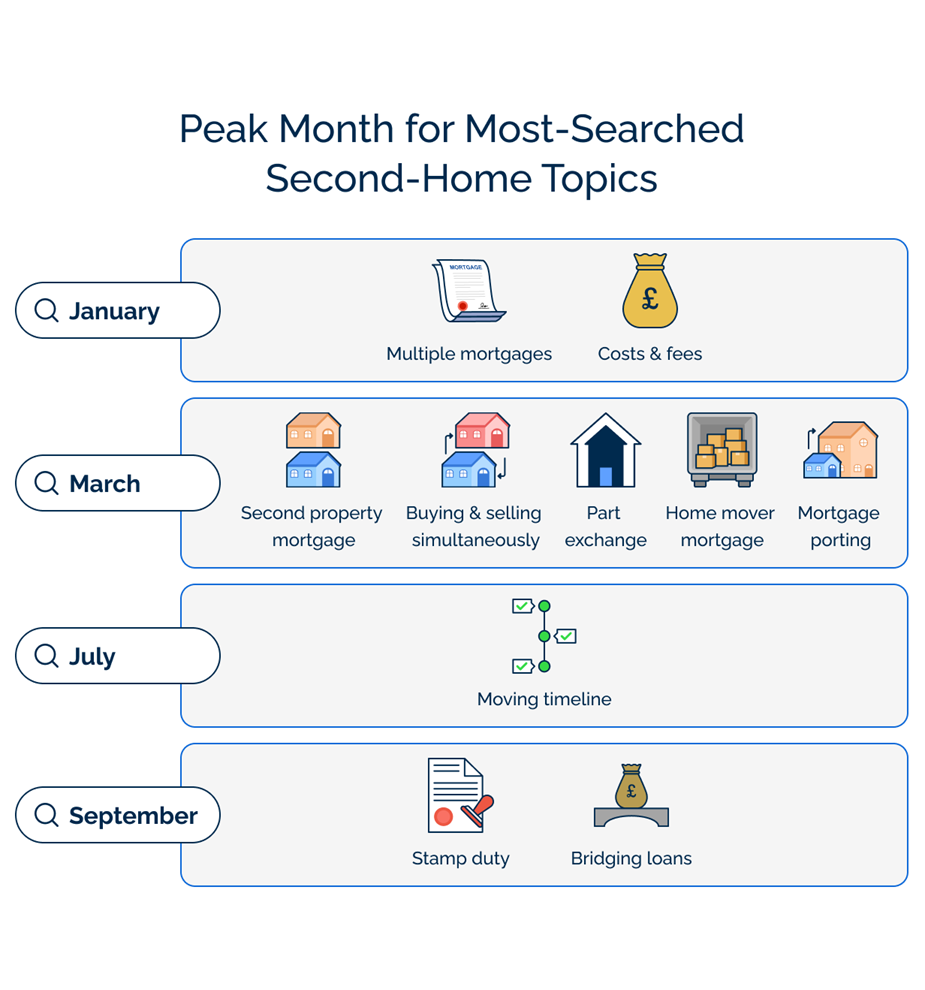
The data revealed that January sees the most searches for mortgages, costs, and fees as Brits begin to consider moving later in the year.
By March, searches peak around second property mortgages, buying and selling simultaneously, part exchange, and mortgage porting, likely reflecting buyers who want to be settled before summer. The timing may also be influenced by the new financial year beginning in April. For self-employed buyers, this is a significant milestone, while those in employment may be searching after pay reviews or bonuses, using the moment to reassess what they can borrow and whether the time is right to move.
July sees a spike in searches around moving timelines, suggesting people are mid-process and trying to navigate completions.
Then in September, stamp duty and bridging loans are searched for frequently as buyers who entered the buying process a few months back come to the final stages of the process.
Moving up the ladder: Second-time buyers share their experiences
Despite the challenges outlined above, there are some ways to make the process easier. The two buyers below both purchased their second homes using our part-exchange scheme, removing the need to list, market, or wait on a separate sale.

David Haasz outside of his home at Newbury Racecourse
David, 32
David was living in a two-bedroom flat for several years before deciding to move to a new home in Newbury and upsize to a David Wilson Homes three-bedroom townhouse. Like many second-time buyers, the prospect of coordinating a sale and a purchase at the same time was a concern. By using a part exchange scheme, he avoided the need to manage viewings or wait for a buyer on his existing property.
He described the experience as "painless", adding, "I didn't have to worry about selling my old place, dealing with viewings, or waiting on other people - everything was handled smoothly, which made the move so much easier."

Edina and Kieran outside of their home in Whitchurch
Edina, 23, and Kieran, 21
Edina and Kieran had previously owned a home together and moved to a David Wilson Home in Whitchurch. Yet, this was their first time navigating a move while also having a property to sell. They described feeling initially stressed at the prospect of managing both sides of the process.
Edina said, "We've moved house before, but this was the first time we had a home to sell as well. We were initially stressed but it was easy... the paperwork was fine."
Their previous home had been an older conversion, and Edina noted that dealing with maintenance issues had been a recurring feature of living there. Moving to a new build meant that concern was removed. She added, "I was very keen on having a brand-new property to make sure everything was fresh and working properly."
Both buyers also noted that using part exchange meant they avoided estate agent fees on their sale, which is a common issue amongst homeowners, with 37% of second-time buyers having underestimated the cost of selling their existing property.
Expert tips for second-time buyers
Our survey found that 83% of homeowners believe property advice and support schemes are primarily geared towards first-time buyers. While first-time buyers benefit from targeted initiatives such as stamp duty relief and dedicated mortgage products, those moving up the ladder often find there is far less tailored guidance available to them. As a result, second-time buyers can feel overlooked, with limited information addressing their specific financial and practical challenges.
To help, Steve Mariner, Sales and Marketing Director, shares the following tips to help second‑time buyers feel more confident through the process.
1. Budget for the extra costs
The additional costs of a second purchase can add up quickly. Stamp duty can be significant as second homes require a 5% surcharge on top of standard rates, making it one of the more important figures to calculate early.
“Separate savings into two pots: one for purchase costs such as stamp duty and legal fees, and one for ongoing running costs including council tax, insurance, utilities and maintenance. Speaking to an independent financial adviser before committing is also recommended.”
2. Complete full legal checks early
The legal process on an older or previously extended property can be considerably more complex than on a first purchase, but this is something second-time buyers commonly underestimate.
“Speak to a conveyancer early to identify potential complications, such as whether the title paperwork is complete, whether there are rights of access to consider, or whether past building work has the correct planning approval.”
3. Clarify the chain structure from the outset
Chain delays are among the most underestimated costs for second-time buyers, with 41% having not fully accounted for them.
“Ask a conveyancer or agent to outline who is involved in the chain, whether all parties have their mortgage arranged, and which searches or surveys are still outstanding so that any delays are less likely to come as a surprise.”
4. Understand planning permission before you commit
Permitted development rights vary depending on property type, location and any alterations already made, meaning what applied on a previous purchase may not apply again.
“Investigate whether any planned renovations or extensions will require planning permission before exchanging contracts, and check this with a solicitor or local planning authority early to avoid unexpected costs after moving in.”
5. Take steps to protect yourself from gazundering
As both a buyer and a seller, second-time buyers are exposed to gazundering in a way that first-time buyers are not.
“Setting a realistic asking price from the outset reduces the likelihood of a buyer having second thoughts after a survey, while moving quickly through the legal process limits the window in which issues can arise. Deciding in advance the lowest acceptable offer can also help avoid making that call under pressure.”
Our research shows many second‑time buyers receive less tailored advice than when they bought their first home. Focusing early on legal clarity, chain communication and financial planning can help make the process smoother and more predictable.
Methodology
We analysed historical Google search volume data from January 2022 to December 2025 for a curated set of keywords related to second-time buyers and home movers, including topics such as stamp duty, downsizing, second mortgages and property chains. Keywords were grouped into broader themes to assess trends at topic level, and average monthly search volumes were calculated across all years to identify recurring seasonal peaks. The “spike month” was defined as the calendar month with the highest average search demand, highlighting consistent patterns rather than one-off market events.
We examined 4,000+ Reddit comments sourced from UK home subreddits, over the past 12 months to ensure relevance. Comments were systematically categorised into three frameworks: conversational themes (e.g. legal, financial, emotional), specific challenge types (e.g. conveyancing failures, chain collapse), and question-led scenarios reflecting real decision points. Each comment was assigned to one or more categories, and engagement was quantified using upvotes as a proxy for the size and importance of each discussion. Categories were then ranked by total upvotes and share of overall engagement to identify the most prominent areas of concern among second-time buyers.
We also surveyed 1,000 UK homeowners in February 2026.
Related Articles
-

Address Changing Checklist
Jul 14, 2025

